The machine is open source
- Memo
- #007
- Date
- 4 November 2026
- From
- Viljami
The UNC 64 is open source. The whole machine: the emulator, the system ROM with UNC BASIC, the assembler, the language server, the Machine Room, the Programmer's Reference Guide, the cassette format, and the five games from the showcase with their source and their tests.
It's on GitHub at github.com/unc64/unc64, MIT or Apache 2.0, your pick, the way Rust projects do it.
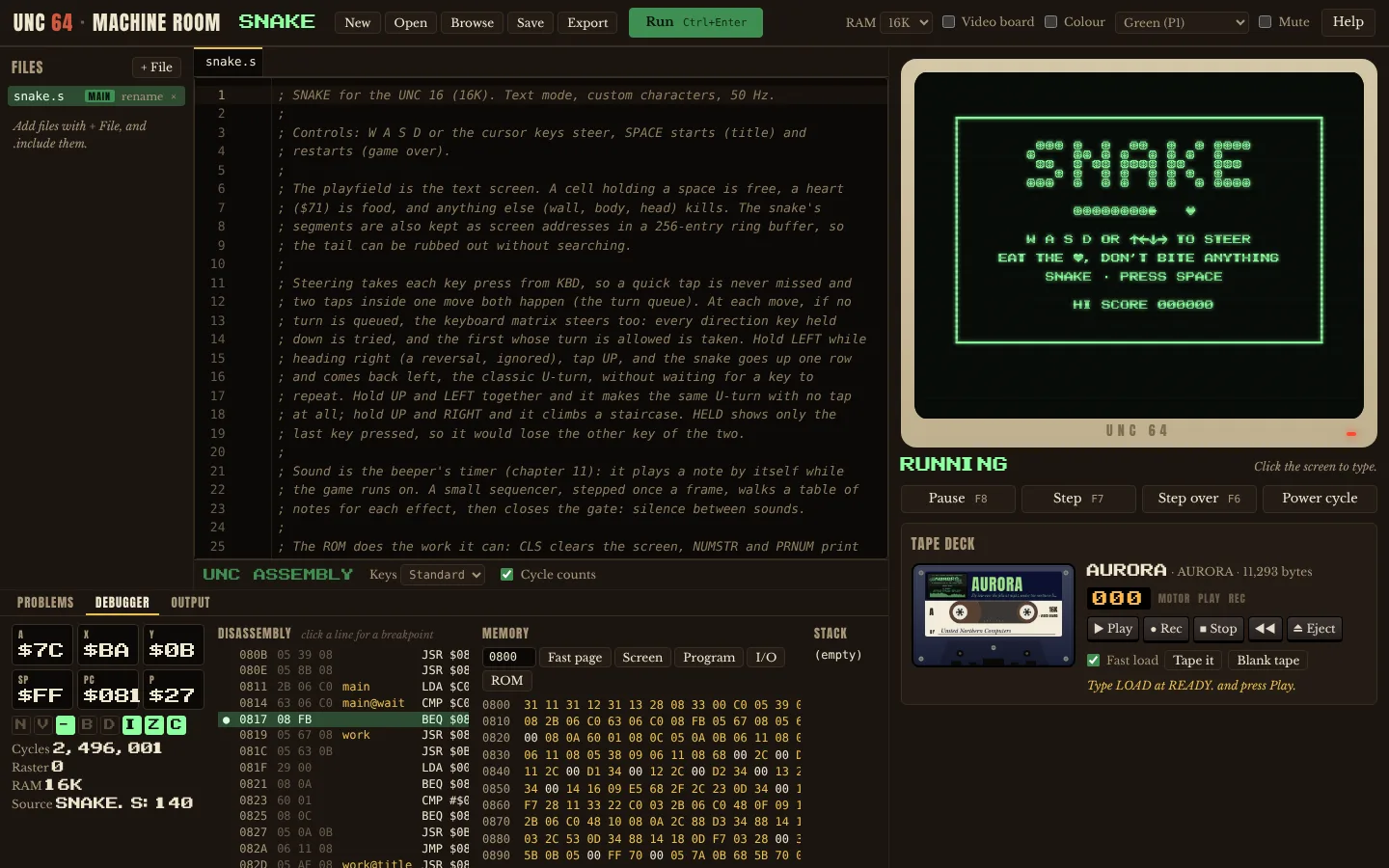
And the Machine Room runs on the web now. Open it, press Run, and you're writing code for the UNC 64. Nothing to install, nothing to buy.
Why give it away
The whole pitch of the game is a computer that fits in your head. 64K of memory, one manual, and you can know all of it.
That's only half true if the machine is a black box. So now it isn't. Every instruction, every cycle, every line of the ROM is there to read. If the manual and the emulator ever disagree, you can go and see which one is wrong.
The other reason is that the machine was never really the product. Nobody buys UNC 64 for the CPU. You buy it for the uncle, the room, the magazine on the desk, the parcel that arrives with the video board, and the slow climb from BASIC to machine code. That's the game, and that's what I'm charging for.
PICO-8 is closed and TIC-80 is open, and both have huge communities making things. What makes a fantasy computer last is people writing programs for it. I want to make that as easy as possible.
Rev A: frozen
Before anything went public, I froze the machine. It's called System Rev A, and the promise is simple: a program written for Rev A runs the same, cycle for cycle, on every UNC that comes after it.
That covers the instruction set and its cycle counts, the memory map, the timing of a frame, the video board, the ROM's jump table, UNC BASIC's tokens and the tape format. A test in the repository holds all of it to what it was on the day it was frozen. Later revisions can only add: a new chip, a new ROM call, a new BASIC keyword. Nothing you write breaks.
Freezing meant deciding the things I'd been putting off. The biggest one: the picture is now drawn line by line, as the beam goes down the screen. Change the background colour halfway down and the bottom half changes colour. Move a sprite after the beam has drawn it and it shows up twice. The real 8-bit tricks work now, and the five games had to learn to stay out of the beam's way.
UNC BASIC got four keywords before the door closed: DATA, READ, RESTORE and GET. Enough for a proper type-in with its tables in DATA lines, and a game that reads the keyboard without stopping.
And the processor does a few things the manual doesn't mention. As on the real 6502. I'll leave that there.
Start here
- The Machine Room, in your browser: an editor, the emulator, a debugger and a tape deck, with the games and samples to open and change. It opens on HELLO.
- The manual: the whole machine in one book, UNC BASIC first. It's also the spec: every listing in it is assembled and run by the tests.
- The repository: clone it and
python3 -m http.server -d web 8064is the Machine Room on your own machine.cargo installgets you the assembler and a language server for Vim and VS Code. - The Discord, to show what you made.
Programs you save in the Machine Room are cassettes, the same files the game loads. Write something on the web today, and it'll be on the desk in 1984 when the game comes out.
What stays closed
The game itself: the story, the room, the magazine, the art and the music.
See you in the Machine Room.
Viljami