Where it comes from
- Memo
- #006
- Date
- 3 November 2026
- From
- Viljami
Nothing in the UNC 64 comes from nowhere.
United Northern Computers is made up, but every idea in it was borrowed from somebody: a game that showed me what a programming game can be, a chip that fits in your head, a magazine that printed programs for you to type in. This memo is the credits.
Thank you, all of you.
Zachtronics
TIS-100 is why this is a game and not only a computer. A programming game with no tutorial, just a short manual that you're expected to print out and read, and a machine that does exactly what the manual says. The UNC 64's skill floor was written down in one line on day one: "TIS-100, exactly." If you can program a little, you can play. No assembly experience required.
SHENZHEN I/O took it further, and gave it a story. You're an engineer who has just moved to Shenzhen for a job at an electronics company, and the story is told in the emails from your coworkers between jobs. The puzzles are your work, and your work is the story. That's the shape of the UNC 64: a story game where every puzzle pays out in story (memo #004 is about that rule).
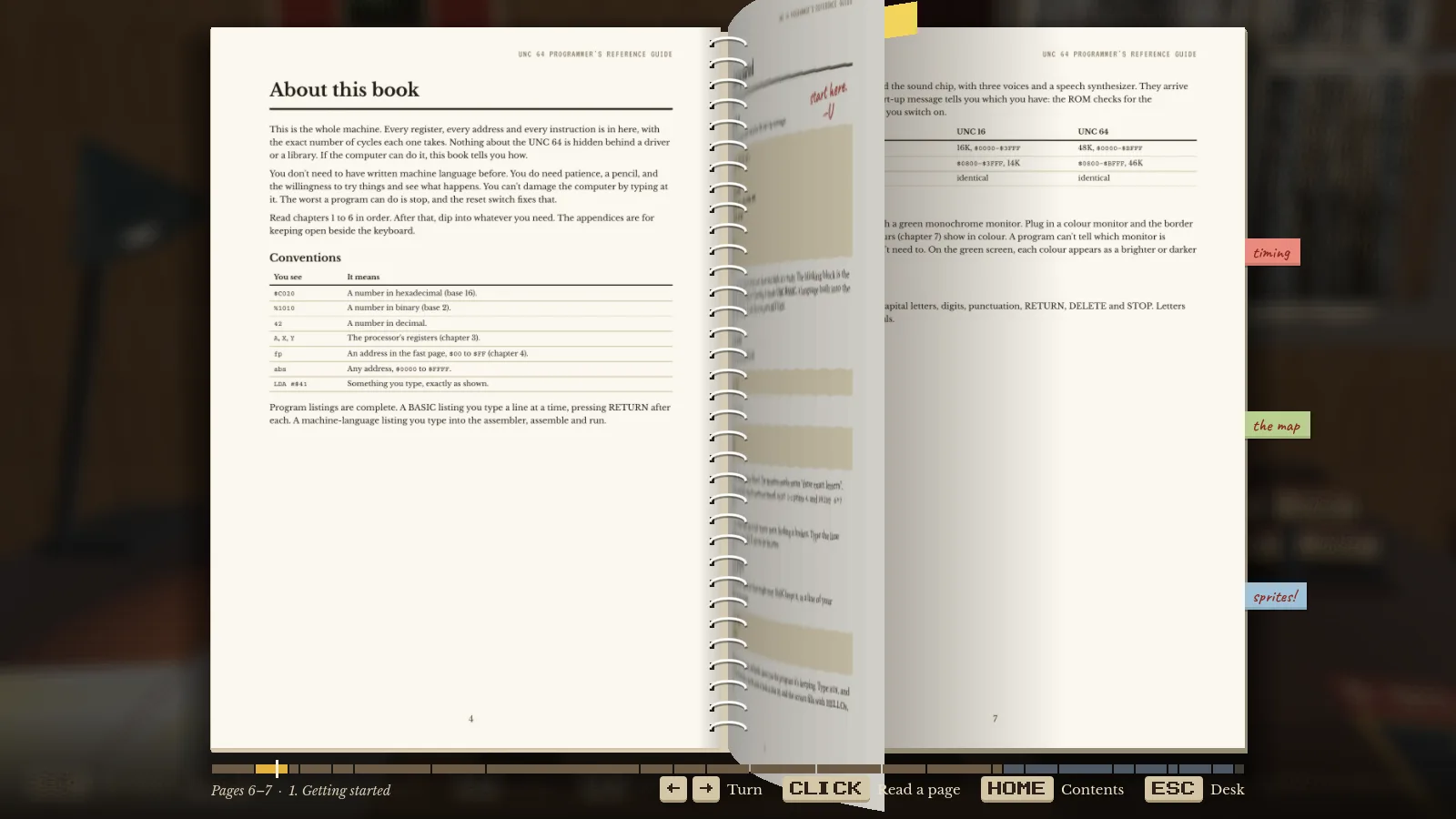
It also came with a binder's worth of datasheets you print yourself, and you're expected to look things up. The uncle's manual on the desk, flagged and scribbled in, is a direct descendant.
Both games also do the thing I like most: once you've solved a puzzle, they show you a histogram of everyone else's cycles and size, and you're immediately not done. The cycle count beside every instruction, and the ASSEMBLER's RAN, BEST and TARGET after every run, come from there.
PICO-8
If Zachtronics showed me the game, PICO-8 showed me the machine.
PICO-8 is Joseph White's fantasy console, from Lexaloffle: a computer that never existed, with a 128 by 128 screen, 16 colours and tight limits on everything, and a code editor, sprite editor and music tracker built in. It came out in 2015, and a decade later people are still making wonderful things on it. It proved that a made-up computer can be a real platform, and that the limits are why people love it.
The UNC 64 owes it more than any other project:
- The quality bar. The very first design decision says the UNC 64 must be "a real platform with a PICO-8-grade quality bar": a toolchain, documentation and sharing good enough to stand on their own without the game. It's a high bar. That's the point.
- The first minute. PICO-8 has you typing a one-liner and seeing something happen within seconds. Chapter 1 of the UNC 64's manual starts the same way:
PRINT "HELLO", a loop, then onePOKEthat changes the colour of the border. - No friction between playing and making. In PICO-8, the game you're playing is one keypress away from its own source. My rule for the UNC 64: friction is fine when it's fiction, like waiting for a tape, and never fine in the tools.
- Cartridges. A PICO-8 cartridge is a PNG with the game hidden inside the picture. A UNC 64 cassette is the same trick with a tape: post it anywhere a picture goes, and it still loads.
- SPLORE. PICO-8's built-in library, where you browse other people's carts from inside the machine. The Machine Room's Browse is my take on it, and its empty Online shelf is where a community library will go.
The clearest sign of how much PICO-8 lives in my head: I keep typing "UNC-8" by accident. It happened often enough that the name is written down in the design log, reserved for later.
Thank you, zep.
Commodore, the PET and the 64
Switch on a UNC and it says READY. That's the Commodore PET (1977) and the Commodore 64 (1982): numbered lines, LIST, RUN, BASIC as the operating system, and a machine you could learn completely.
They taught me BASIC before I ever saw one. The library books I learned from as a kid were full of listings for the PET, the VIC-20 and the C64, and I typed them into my Amiga, which was close enough. My uncle had a C64 before his Amiga, too.
From them, also: the graphics characters in the character set, which owe everything to PETSCII. The stripes in the border while a tape loads. A cassette deck that runs at the speed of tape. And the name of the manual. The C64 had a Programmer's Reference Guide, and so does the UNC 64.
The rest of the 1980s bedroom is in there too, on purpose: the Apple II and ZX Spectrum scenes, the IBM PC's beeper (a timer drives the speaker, as memo #003 explains), and the lines and circles I had on my Amiga 500 as a kid.
The 6502
The MOS Technology 6502 came out in 1975 at $25, when the chips it competed with cost several times that. It ended up in the Apple II, the Commodore PET, VIC-20 and 64, the Atari 2600, the BBC Micro and the NES. A generation learned assembly language on it.
And I've watched more of Ben Eater's videos, building a 6502 computer on breadboards, than is probably healthy. Thank you, Ben.
The UNC-1 is in its family, cleaned up the way you'd do it today: fixed cycle costs, a regular encoding, a "fast page" where the 6502 had zero page, and no decimal mode (memo #003 says why). If you know 6502 assembly, you can read UNC assembly. If you learn UNC assembly, a 6502 won't scare you.
The Game Boy and the NES
The video board is a Nintendo kid's idea of an upgrade.
From the Game Boy (1989): four colours, and a picture that works in four shades of grey when you don't have a colour monitor. Also the sprite table in memory, four bytes a sprite: Y, X, the image and a byte of flags for flipping it and putting it behind the background. If you've written for the Game Boy, the UNC 64's sprite table will look familiar.
From the NES: eight sprites on a line. Put more than eight on one line and the extra ones aren't drawn. Every NES game had to design around that limit, and so does every UNC 64 game.
The magazines
In the 1980s, magazines printed programs, and you typed them in (or, in my case, library books). Pages of them. Then it didn't run, because you'd made one typo on page three.
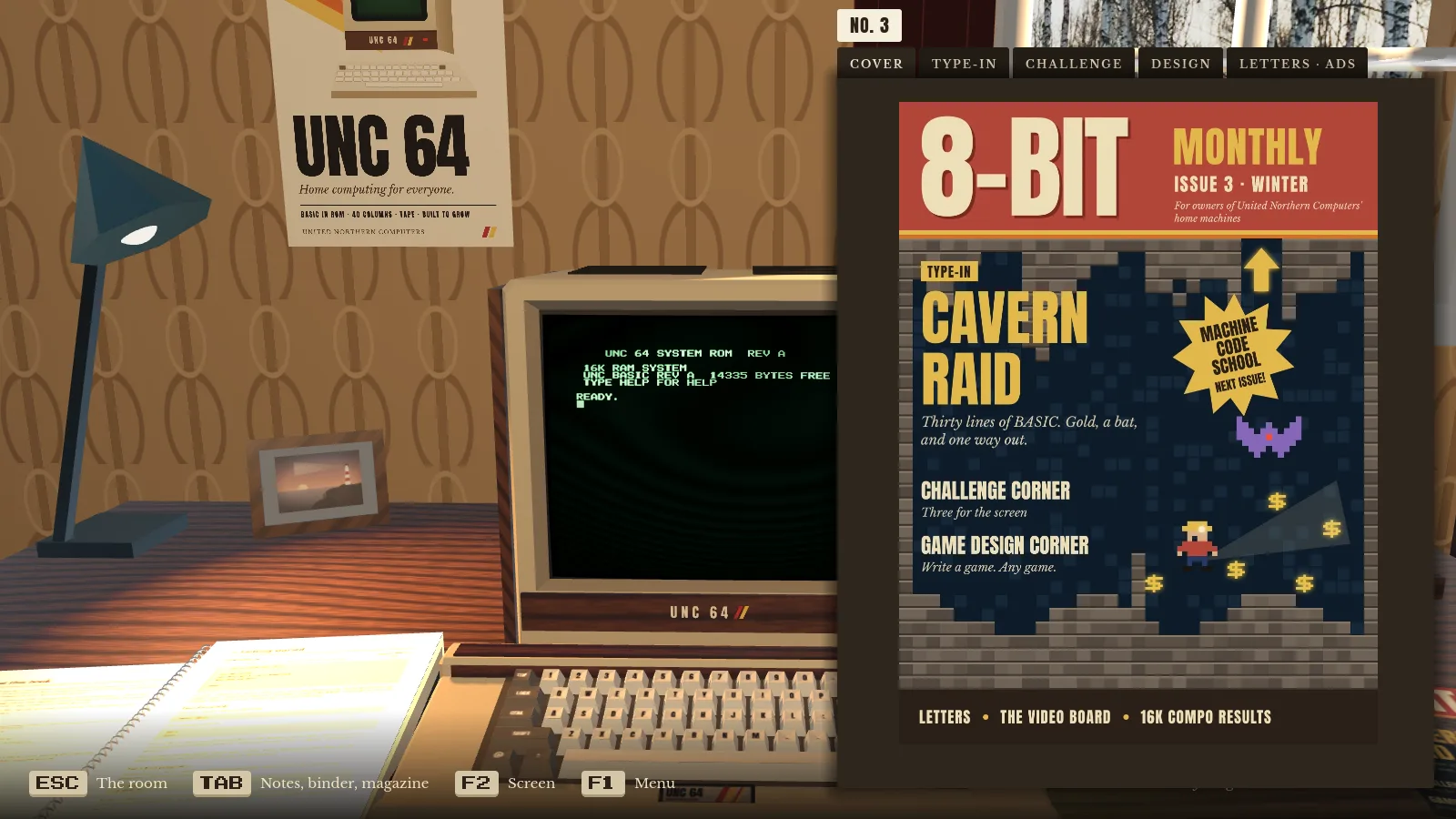
The good magazines fought back with checksums. COMPUTE!'s Automatic Proofreader printed a short code beside every line, so you could find the line you got wrong. The magazine in the game does the same. And as memo #004 tells, sometimes the code says the magazine is wrong, not you.
The games on the showcase
Each of the uncle's tapes is a classic genre with a twist, and each genre has someone to thank:
- SNAKE: the snake game, from Gremlin's arcade Blockade (1976) to the version on everyone's Nokia phone. Text mode, custom characters, don't bite yourself.
- STACK: Tetris, by Alexey Pajitnov, from 1984, the same year as the desk in the game. STACK's pieces are three cells instead of four, and every eighth one is a bomb.
- ORBIT: Atari's Asteroids (1979), rocks that split when you shoot them, around a small planet with gravity, the way the two ships in Spacewar! (1962) circled their star.
- DEBUG: Taito's Space Invaders (1978). A formation that marches, steps down and speeds up as it thins out. Here it's bugs, and they drop exceptions.
- AURORA: the side-scrolling shooters of 1987, Irem's R-Type and Hewson's Zynaps, which is the bar the video board had to clear. The fells and the northern lights came from closer to home.

The tools
The emulator is written in Rust and runs in your browser as WebAssembly. The game is built in Godot. The Machine Room's editor is CodeMirror. The fonts are Anton (Vernon Adams), Caveat and Libre Baskerville (Impallari Type), VT323 (Peter Hull) and Courier Prime (Alan Dague-Greene), all under the Open Font License.
All free, all made by people who didn't have to share them. Thank you.
If I've forgotten someone, it's not on purpose. Tell me on Discord and they go on the list.
Back to the machine.
Viljami