Puzzles that pay out
- Memo
- #004
- Date
- 2 November 2026
- From
- Viljami
Part one of the story is playable now, from the first PRINT "HELLO" to the parcel on the hall table.
So I played it. Then I had a robot play it, over and over.
Some of the puzzles weren't fun. This memo is about why, and the rule that came out of it.
A robot that plays the whole thing
The game has an autoplay: a script that sits at the desk and plays part one the way a player would. It types the programs, loads the tapes, reads the magazine, goes to sleep and photographs every story beat on the way. If it can't reach the end card, the build is broken.
At first a full playthrough took about 25 minutes, and every now and then a run just hung. Not great for a feedback loop.
The fixes were boring and they worked:
- Fast mode. The test machine has no graphics card, so it drew the room at one or two frames a second. Almost all of those frames were thrown away. Now only the photographed frames get drawn and the game's clock runs 4x. I measured 1x to 32x: from 12x up the story falls out of step and it even gets slower, and 4x was the sweet spot.
- Turbo tape. In fast mode the tape deck hands over each byte the moment the ROM has read the last one. It's still the ROM's real LOAD routine, only as fast as it can read.
- A watchdog. Every step of a run says how long it's allowed to take. A step that overruns ends the run with where it got stuck and a screenshot.
Part one now plays end to end in about two minutes. Every run of every mode in about six.
What wasn't fun
The first real puzzle in the game is CAVERN RAID, a type-in from issue 3 of the magazine. Kevin, aged 15, wrote it. The magazine printed it with two bugs in it, as magazines did.
Playing it, here's what I actually did:
- Typed 30 dense lines, and then debugged my own typos first. They looked exactly like the magazine's misprints, so finding the real ones wasn't a reward.
- Squinted at an O that should have been a 0. That's spot the difference, not a puzzle.
- Stood on the exit arrow and nothing happened. Was the game broken, or was I bad at it? There was no way to tell, so most players would just wait for next month's corrections box.
Then Mr. Berg, the newsagent, asked me to sort his stock list in under a minute. I knew how. I still didn't want to.
Here's the honest version: implementing sorting algorithms isn't most people's idea of fun. It isn't mine either.
What is fun is making code run in fewer cycles, with a counter that tells you straight away whether you got closer. Run it, see the number, change one thing, run it again. That loop is what TIS-100 nailed, and it's the loop this game should be built around.
The rule
Decision #26 in the design log now says two things.
Every puzzle pays out in story. Solving one has to make something happen and reveal something, not just tick a box on your notes.
The game hands you the algorithm, and the puzzle is making it fast. Mr. Berg's nephew already wrote a sort. It's on the tape, it works and it takes eleven minutes. A stopwatch shows every run you make. Your job is to find out where the time goes.
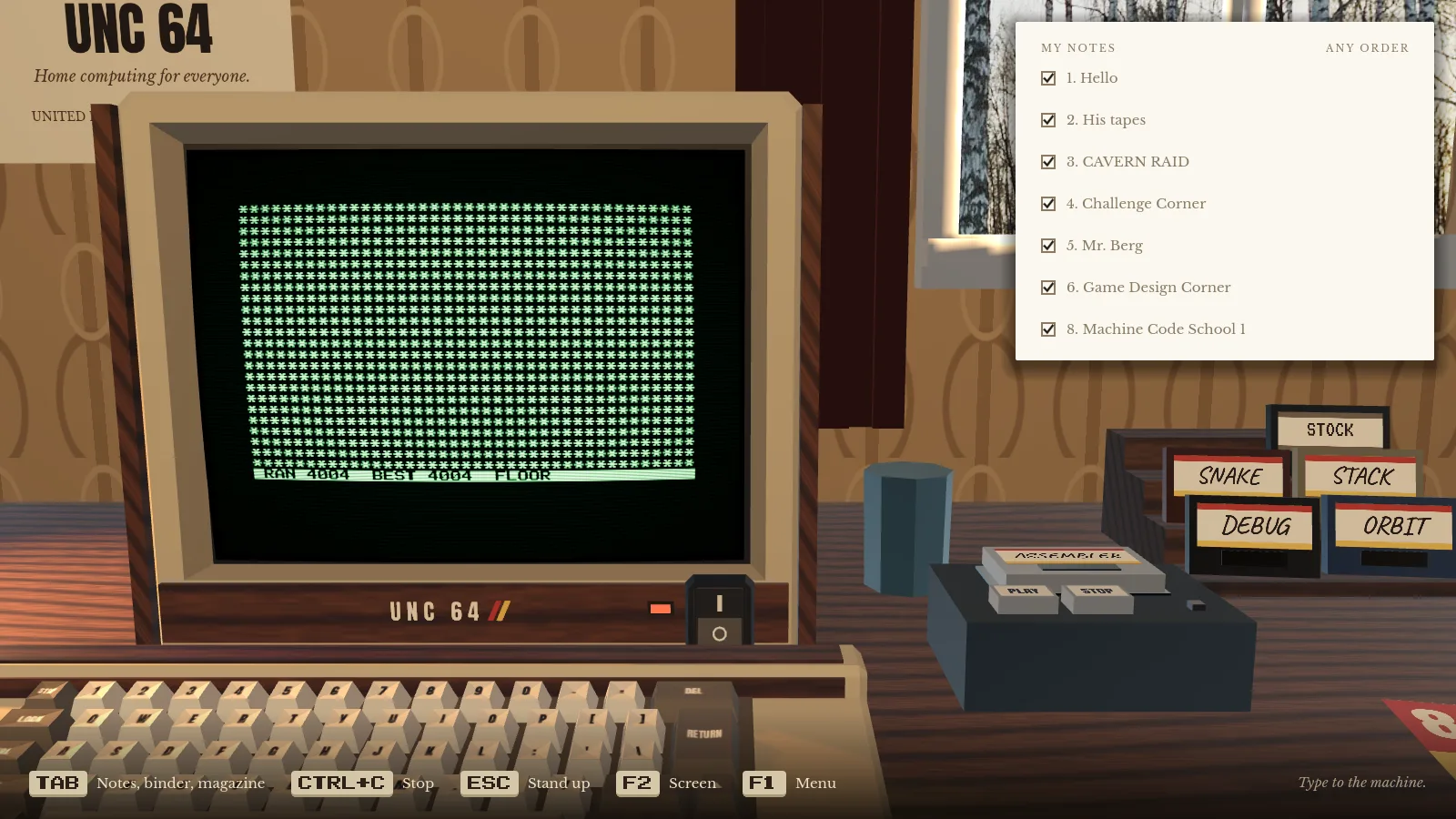
The ASSEMBLER tape got the same treatment. After every run its status line shows your cycles, your best and the next target, so RAN 6255 BEST 6255 TARGET 6000 becomes a game you play with yourself. Shave the loop, run it again, watch the number drop. At the bottom of the ladder it just says FLOOR: there's nothing left to take out.
The magazine prints a chart of the readers' cycle counts the next month, with yours marked. One of the entries on it is impossible. I'll leave that there.
CAVERN RAID, take two
The magazine now prints a two-character proofreader's code beside every line of the listing, like the real magazines did. Your notes check every line you type against its code.
Your own typos show up as mismatches straight away, so they're quick to fix. But lines 70 and 110 fail their codes even when you've typed them exactly as printed. That's the clue: the magazine is wrong, not you.
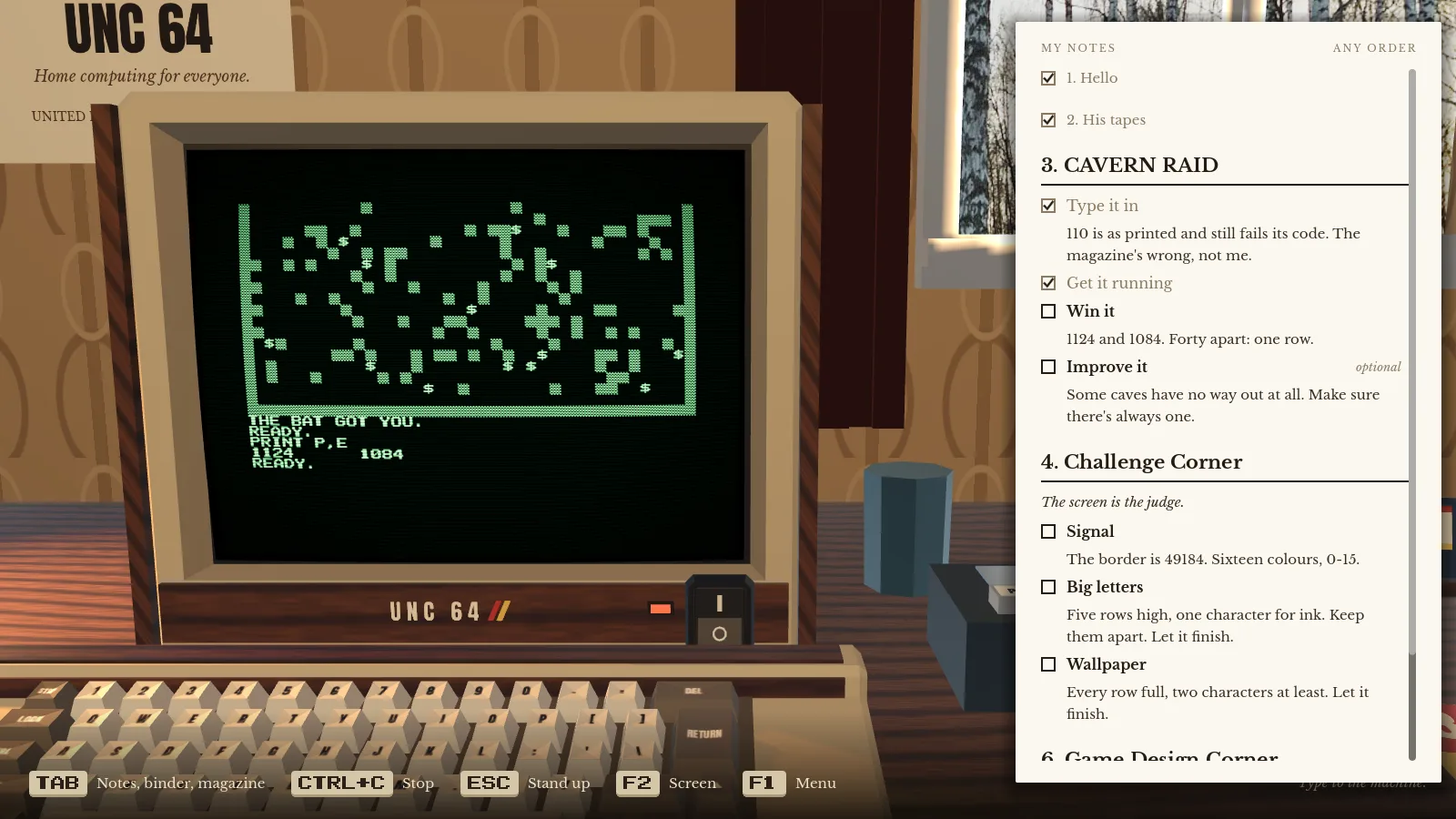
Line 70 is the O. Line 110 is the good one: you stand on the arrow, nothing happens and your notes notice. So you STOP the game and ask it: PRINT P,E. Where you are, and where it thinks the exit is. It answers 1124 and 1084. Forty apart: exactly one row on a 40-column screen.
That moment, asking the machine a question and getting back a number that explains the bug, is the most important skill in the whole game. So now it's the first real puzzle.
And if you fix it yourself, the next issue's letters page has something in it that shouldn't be possible. Not spoiling that one.
What the robot found
Playtesting by script turned out to be a lot more useful than "does it reach the end". Some of what it caught:
- The improvement challenge was impossible to need. The plan was that Kevin's random walls sometimes leave no way out, and you fix that. The robot measured 40 caves: zero were blocked. One line of his listing changed, and now about one in four is.
- The hint quoted numbers I'd made up. I'd written 1100 and 1060. The machine prints 1124 and 1084. The hint now uses what the machine actually says, which is the only rule in this project that never bends (memo #003: the manual is the spec).
- Dying on the arrow didn't count. The game checked four times a second whether you were standing on it. A bat that got you within a quarter of a second meant you'd never been there, as far as the game knew. A real player would have hit that and decided they were doing it wrong. Now the game looks at where you died.
- A reward showed up for the wrong person. Something in the uncle's unfinished game is meant to appear only when it finally runs at full speed. In the first build it also appeared in his own slow version, with as few as one bird on screen. It now needs full speed and a proper flock.
None of these were crashes. They were all design mistakes, and every one of them would have reached players.
Thinking out loud
The player character is a programmer from 2027 who wakes up in 1984. That's been true since the beginning, but you never heard what they thought about it.
Now you do. There are 81 small asides scattered through the game: a line of italics that fades in and out by itself and never gets in the way of your typing.
Some of my favourites:
- Press the up arrow for your last command: "You thought there'd be a history?"
- Try to fix a letter in the middle of a line: "Too advanced. DELETE, from the end."
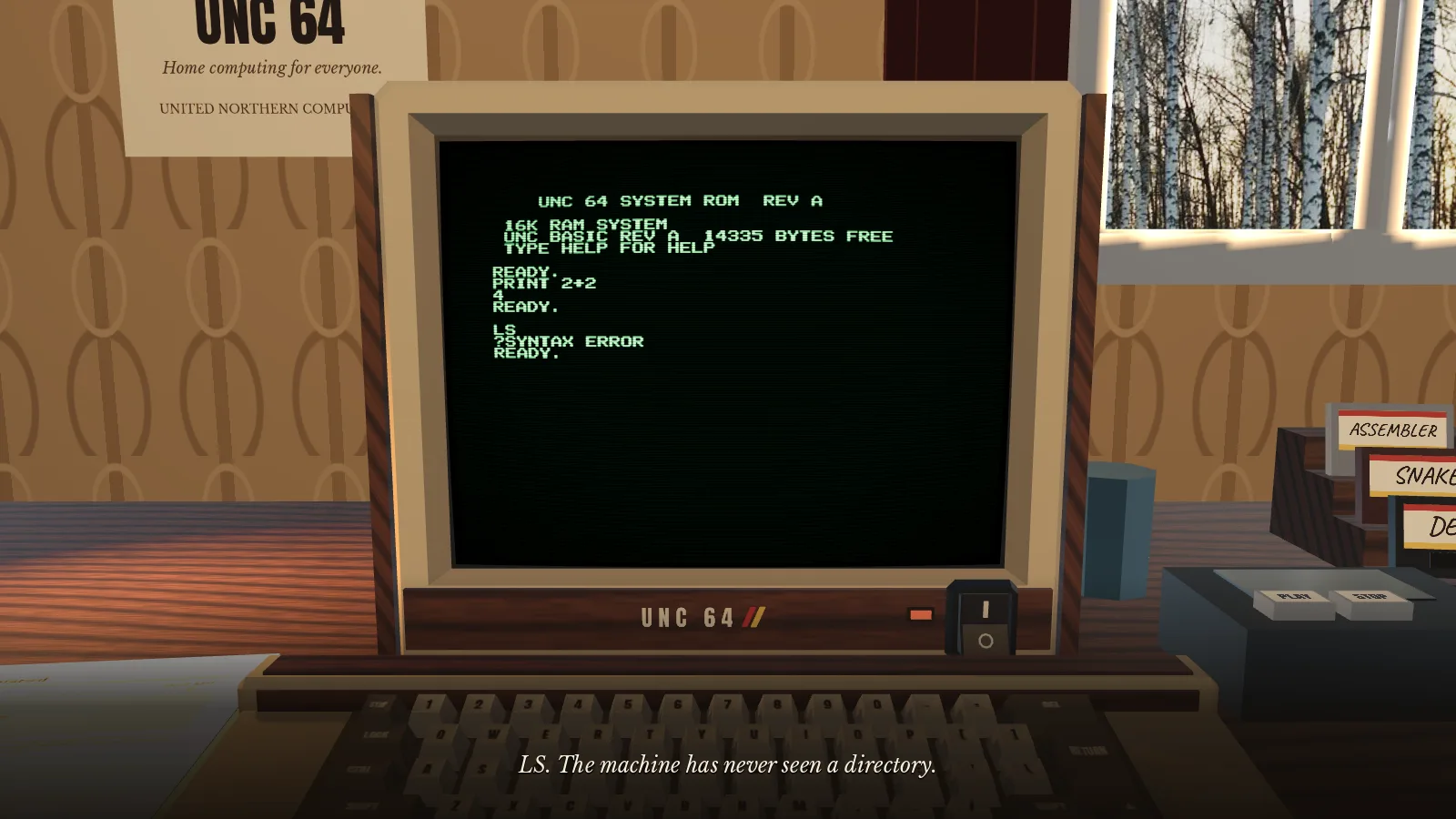
PRINT 7/2: "7/2 is 3. Whole numbers only, and nobody apologises."- The first tape load: "Six hundred bytes a second. You once called a web page broken for taking this long."
- The first morning: "You reached for your phone before you opened your eyes. It'll pass."
Each one fires once. They're a toggle in the pause menu if you'd rather not hear yourself think.
It's winter now
One more story change: part one happens in January 1984. There's snow outside the window, and the low winter sun comes in sideways in the morning.
It suits the story. Long dark evenings and the warmest light in the room coming from the screen.
Next up is more playtesting, with humans this time.
Viljami